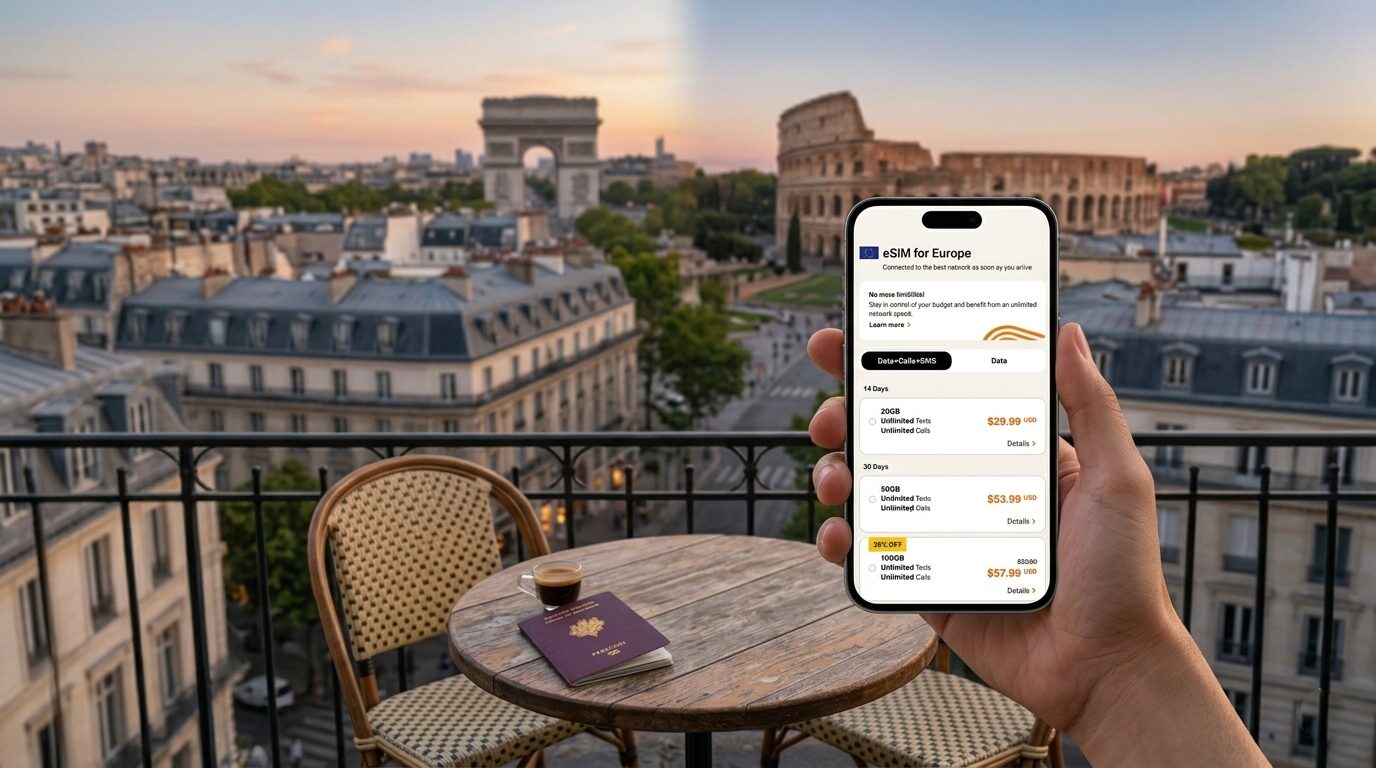
The Best eSIM for Travel: Skip the SIM Card Chaos
eSIM for travel is a digital SIM that lets you connect to local networks abroad without needing a physical card. You simply scan a QR code or download a plan before your trip, then activate it when you arrive. This means no more hunting for local SIM shops or facing surprise roaming charges, keeping you connected the moment you land.
What Exactly Is a Digital SIM and Why Global Travelers Need It
A digital SIM, or eSIM, is a programmable chip embedded in your device that replaces the physical plastic card. For global travel, this means you can instantly purchase and activate a local data plan online before you even board your flight. The core advantage is that you keep your primary home number active for calls and OTPs while running a separate travel data plan on the same phone. You avoid hunting for local SIM kiosks, paying inflated roaming fees, or swapping cards that risk loss. Instead, you simply scan a QR code or install a profile, and you are connected the moment you land. This fundamentally makes seamless connectivity for travelers a tap-away reality, not a logistical headache.
How a programmable chip replaces your physical plastic SIM card
A programmable chip, embedded directly into your device, eliminates the need for a physical plastic SIM by storing your carrier profiles digitally. Instead of swapping tiny cards, you use software to download and switch between carrier profiles instantly, with a simple scan or menu tap. This eSIM chip is soldered onto your phone’s motherboard, so it’s permanent—you never remove it. When you travel, you just buy a new plan online, receive a QR code, and activate it, replacing the old plastic card’s role entirely. No more fumbling with ejector tools or losing tiny SIMs at an airport.
Q: Does the programmable chip physically hold multiple SIMs at once? Yes, the chip allocates secure storage space for several profiles, but only one can be active at a time—you switch between them virtually, not by swapping plastic.
The real difference between roaming fees and local digital SIM rates
The real difference between roaming fees and local digital SIM rates comes down to pricing structure. Roaming fees charge your home carrier’s daily or per-MB rate for using foreign networks, often adding surcharges that quickly exceed a plan’s base cost. A digital SIM bypasses this by letting you purchase a local data package directly from a regional provider at native rates, typically far lower per gigabyte. For example, a one-day roaming pass might cost $10 for 500 MB, while a local digital SIM plan offers 5 GB for the same price. This makes local digital SIM rates the practical choice for affordable mobile data abroad.
| Aspect | Roaming Fees | Local Digital SIM Rates |
|---|---|---|
| Cost per GB | High (e.g., $8–$20/GB) | Low (e.g., $1–$4/GB) |
| Billing model | Daily pass or usage surcharge | Fixed prepaid data volume |
| Network access | Home carrier’s partner towers | Direct local carrier network |
Which devices support this embedded technology in 2025
By 2025, nearly all recent flagship smartphones support embedded eSIM technology for travel, including the iPhone 15 and 16 series, Google Pixel 8 through 10, and Samsung Galaxy S24 and S25 models. Many mid-range Android devices like the Galaxy A-series (A54 and later) and Pixel 7a also include it. Most iPad Pro and Air models released after 2023, along with select Windows laptops such as the Surface Pro 10, feature embedded eSIMs. For travelers, this means you can activate a local data plan without a physical SIM card, provided your specific carrier or device model supports over-the-air provisioning.
In 2025, eSIM support is standard on premium smartphones and tablets from Apple, Google, and Samsung, with growing availability in mid-range devices and laptops, allowing direct plan activation without swapping physical SIMs.
Choosing the Best Mobile Data Solution for Your Next Trip
When choosing the best mobile data solution for your next trip, prioritize an eSIM that offers direct, local network access in your destination to avoid throttling. Look for plans with transparent pricing and no hidden daily caps, not just total data volume. Always verify your device’s eSIM compatibility and carrier lock status before departure to prevent activation failures. Compare plans that allow easy top-ups or plan switching, as connectivity needs can change mid-trip. An eSIM provider with a reliable app-based management interface can save hours of hassle when you land. Select a plan matching your specific usage, like a data-only eSIM for navigation and messaging. This targeted approach ensures seamless, cost-effective connectivity without physical SIM swaps.
Comparing prepaid data packages versus pay-as-you-go plans
When comparing prepaid data packages versus pay-as-you-go plans for travel eSIMs, the core difference is predictable coverage versus flexible spending. Prepaid packages lock in a fixed data allowance (e.g., 5GB for 10 days) at a set price, ideal for heavy, planned usage. Pay-as-you-go plans deduct from a wallet balance per MB, better for light, sporadic users. For example, if you need constant navigation, a prepaid package prevents runaway costs. Missed usage is the risk with prepaid: unused data expires. Q: Which plan saves more on a two-week trip with moderate data use? A: Prepaid packages, as their per-GB rate is typically lower than pay-as-you-go’s cumulative charge per megabyte.
Top regional providers for Europe, Asia, and the Americas
For Europe, regional eSIM providers for travel like Airalo and Holafly offer seamless multi-country coverage via single plans, eliminating SIM swaps. In Asia, Ubigi and eSIM2Fly deliver fast connections across Japan, South Korea, and Thailand, often with local pricing. For the Americas, GigSky and Jetpac provide solid LTE across the US, Canada, and Brazil, with easy top-ups. These specialists ensure reliable, high-speed data where global roaming fails.
- Airalo delivers Europe-wide plans starting at 1 GB for 7 days.
- Ubigi offers Japan and Korea-specific high-speed data without throttling.
- GigSky covers North and South America with pay-as-you-go flexibility.
Evaluating unlimited data options against high-speed capped plans
For your trip, evaluate unlimited data options against high-speed capped plans by first calculating your actual usage. A 10GB high-speed plan often beats an “unlimited” plan that throttles to 2G speeds after a small daily cap, making video calls or navigation impossible. Choose the right balance of speed and volume based on activities like streaming versus messaging. Unlimited plans are only valuable if their high-speed allowance realistically covers your peak usage hours.
Q: Which option saves money? A: For light users, capped high-speed plans cost less; for heavy streamers, unlimited prevents overage fees, but verify the speed-reduction policy.
Step-by-Step Setup: Activating Your Connection Before Departure
Sarah opened her laptop at the kitchen table the night before her flight, ready to tackle her eSIM for travel setup. She purchased the regional plan directly from the provider’s app, then scanned the QR code emailed to her. A notification appeared: “Add Cellular Plan?” She tapped “Continue” and labeled it “Europe Trip.” The step-by-step setup finished there—no physical card swap or carrier call. She turned on the eSIM line, disabled her home SIM’s data roaming, and ran a quick speed test. Bars filled instantly. Satisfied, she zipped her bag, knowing her connection would be live the moment she touched down in Paris.
Scanning a QR code or using a provider app to install a profile
After purchase, you activate your eSIM by scanning a QR code or using a provider app to install a profile. The provider emails you the QR code or prompts app-based installation. Scanning through your phone’s settings menu directly pushes the cellular profile onto your device, while the app method automates this by fetching and applying the configuration. App-based installation often verifies device compatibility before the profile is written, reducing setup failures. Either method takes under two minutes. Q: Can I install the profile before my trip? A: Yes, install it anytime before departure; the profile remains dormant until you activate the data plan on arrival.
Managing dual SIM modes for keeping your home number active
To keep your home number active while using an eSIM for travel, configure your phone’s dual SIM mode to assign your primary physical SIM for voice and SMS, while setting the eSIM as the default for mobile data. On most devices, navigate to the SIM manager settings and disable “Cellular Data Switching” to prevent the home line from consuming roaming data. Enable “Voice Roaming” on the home SIM to receive calls and texts, but disable “Data Roaming” on that line to avoid charges. This dual SIM management technique ensures your home number remains reachable without incurring unexpected fees.
Keep your home SIM for calls and texts, set the eSIM for data, and disable data roaming on the home line to maintain connectivity without extra costs.
Troubleshooting common activation errors and connectivity issues
If activation fails, first ensure your device is unlocked and eSIM-compatible. A common error, “No Service,” often arises from incorrect APN settings; manually input your provider’s APN. For connectivity issues, reset network settings after scanning the QR code. Roaming must be explicitly enabled for the eSIM line, not just your primary SIM. Follow this sequence:
- Toggle Airplane Mode for 30 seconds.
- Select the eSIM line as the default for cellular data in settings.
- Manually search for a network provider in your location.
Persisting “Invalid QR code” errors require re-downloading the eSIM profile from your provider’s account portal.
Cost Savings and Hidden Fees to Watch For
For travel, eSIMs primarily save costs by eliminating physical SIM shipping and offering local data packages far cheaper than international roaming from your home carrier. However, watch for hidden fees like “top-up” minimums that force you to buy more data than you need for a short trip, or activation fees disguised as “service charges.” Some providers apply daily “connection fees” that drain your balance even if you only use data sporadically.
Always read the fine print for automatic renewal policies, as losing track can lead to billing for an expensive plan you no longer require.
To maximize savings, always compare the total price of a small data add-on against a larger package, and ensure the provider doesn’t charge for eSIM profile downloads or reinstallation after deletion.
How much you can save compared to traditional international roaming
Switching to an eSIM can slash your connectivity costs by up to 80% compared to traditional international roaming. Instead of paying your home carrier’s daily fees—often $10 to $20 per day—you purchase a regional or local data plan for a flat fee, typically $5 to $15 for an entire week. This eliminates the shock of bill shock from per-megabyte roaming charges. Even heavy data users see drastic savings, as eSIM plans offer generous high-speed data for a fraction of the price. The key advantage is dramatic cost reduction without sacrificing connection, allowing you to stay online for your entire trip without constantly monitoring usage or returning to expensive daily add-ons.
Understanding data throttling, fair usage policies, and top-up costs
Understanding eSIM data throttling policies is crucial to avoid surprise slowdowns. After you exhaust your high-speed allowance, many plans drastically reduce speeds to near-useless levels for navigation or messaging. Fair usage policies often cap unlimited data at 1–5GB daily before triggering throttling, not true ‘unlimited’ access. Top-up costs vary wildly between providers, so check if recharging is instant or requires a new plan purchase. To stay in control:
- Compare throttle speeds (e.g., 256kbps vs. 1Mbps) and fair usage caps before buying.
- Identify if top-ups unlock full speed again or merely extend a throttled state.
- Calculate total cost if you need multiple top-ups for your trip.
Currency conversion tricks and regional pricing variations
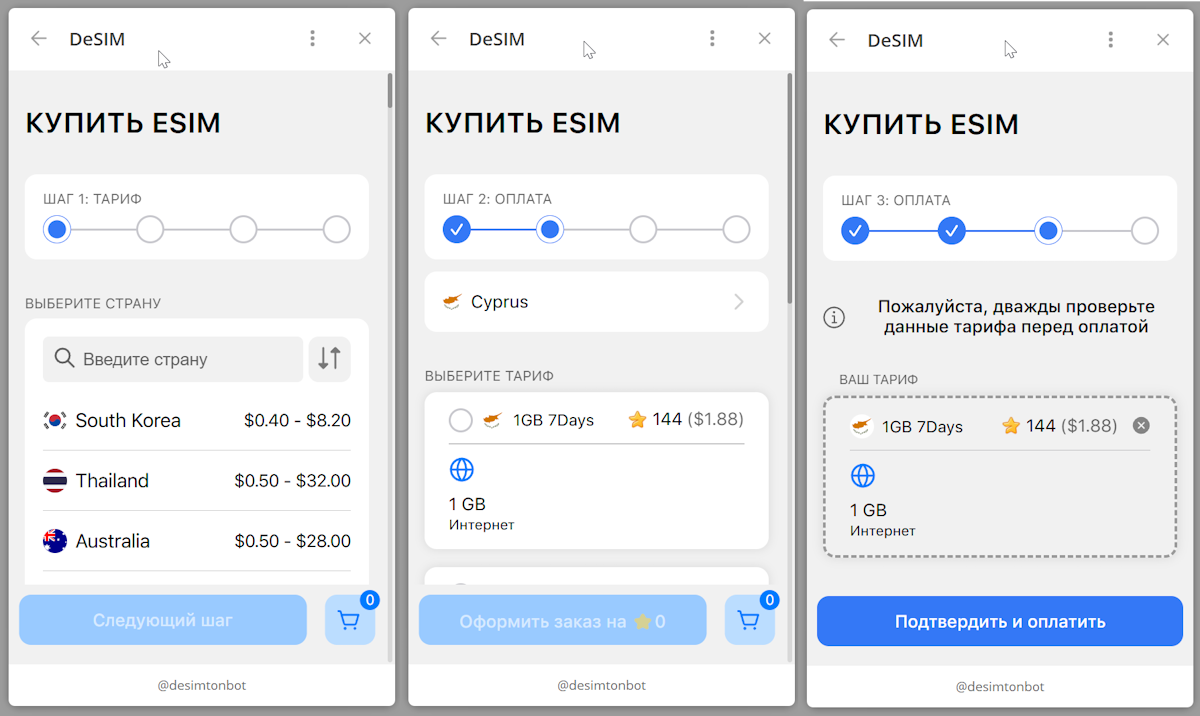
Savvy travelers exploit regional pricing variations by purchasing eSIMs in the local currency of the destination, avoiding inflated dollar conversions. Currency conversion tricks often hide in the checkout process: always pay in the plan’s native currency, never your home currency, or you’ll lose 3-5% to dynamic conversion fees. To maximize savings, follow this sequence:
- Select a plan priced in the destination’s local currency.
- Reject the payment prompt’s offer to convert to your home currency.
- Let your bank handle the conversion with its own, often lower, exchange rate.
For regional plans, check if a plan covering multiple countries actually saves money versus buying separate local plans, as some regions have wildly different base prices.
Coverage and Speed: What to Expect in Different Regions
In major urban centers of Europe, North America, and parts of Asia, eSIM coverage is typically extensive, often matching or exceeding native networks with 4G LTE or 5G speeds. Travelers in these regions can expect reliable, fast data for streaming and navigation. However, coverage diminishes significantly in rural or remote areas, such as mountain ranges, deserts, or deep forests, where only 3G or edge connectivity may be available, if at all. Q: Why might eSIM speed be slower in Southeast Asian rural islands? A: Local carrier infrastructure often lacks advanced towers, so eSIMs in these regions default to slower 3G or 2G bands. In contrast, metropolitan Japan and South Korea offer nearly ubiquitous high-speed connectivity via eSIM, while parts of Africa and South America may have only spotty 4G in capital cities, degrading to 2G outside them.
5G availability on digital SIMs across major tourist destinations
For travelers using eSIMs, 5G availability on digital SIMs across major tourist destinations varies significantly. In cities like Tokyo, London, and New York, major eSIM providers offer stable 5G connections, often with speeds exceeding 200 Mbps on local networks. However, in popular but less-developed hubs like Marrakech or Bali’s rural beaches, 5G coverage remains patchy, with many eSIMs defaulting to fast 4G LTE. Roaming profiles on digital SIMs sometimes limit 5G access to preferred partner networks, so checking carrier-specific coverage maps before departure is practical. For consistent high-speed data, tourists should verify that their chosen eSIM explicitly supports 5G in their destination cities.
Rural and remote connectivity performance for off-the-grid travelers
For off-the-grid travelers, rural and remote connectivity performance hinges on low-band spectrum availability, as eSIMs lack inherent signal advantage over physical SIMs. In deep wilderness, you may achieve only 2G or 3G fallback speeds (<1 mbps), sufficient for text-based sos messages but not maps or voice calls. performance follows a predictable sequence:
- First, verify that your eSIM provider’s partner networks include carriers with extensive rural infrastructure, not just urban coverage.
- Second, download offline maps before departure, as data throughput will be erratic even with a strong signal.
- Third, accept that during peak travel seasons, shared tower bandwidth in remote zones can drop to sub-100 Kbps, making any real-time app unusable.
- Pre-load profiles for each stop on your itinerary before you leave home
- Label each profile by country or trip date to avoid confusion
- Keep a backup global profile active for emergencies between destinations
- You must present a physical passport at a carrier shop to download the profile.
- Remote activation may be disabled entirely within the country’s borders.
- Tourist eSIMs from foreign providers are blocked by local network filters.
- Pre-travel installation of a global eSIM may fail if the carrier lacks local approval.
Ultimately, reliability in these zones depends more on tower density and frequency bands than on the eSIM technology itself.
Network prioritization and VPN compatibility for secure browsing
When using an eSIM abroad, your data speed often depends on network prioritization for travel eSIMs. Some providers throttle speeds after a certain limit or deprioritize your traffic compared to local users during peak hours, which can make maps or streaming lag. For secure browsing, check if your eSIM is VPN-compatible—some regional networks block VPN protocols, leaving your credit card logins or messages exposed over public Wi-Fi. A solid travel eSIM should allow WireGuard or OpenVPN to run smoothly, keeping your banking and messaging encrypted even on slow, congested towers.

Prioritization affects peak-hour speed, so choose an eSIM with consistent data tiers; VPN compatibility ensures your browsing stays encrypted on any local network.
Managing Multiple Trips and Long-Term Stays
For travelers juggling back-to-back trips or settling in for months abroad, an eSIM eliminates the hassle of swapping physical SIMs at every border. You can pre-load multiple data plans from different regions onto one profile, switching between a Japan plan for a week and a European one for the next month instantly. With long-term stays, you simply top up or renew your plan remotely, avoiding local carrier contracts. This flexibility means you can maintain a single, active number for banking and family while using a separate, high-capacity data plan for streaming and work. Planning ahead and staggering plan expiration dates prevents service gaps during overlapping travel windows. However, note that some countries block eSIM activation if your phone connects to a local network before registration, so install new plans while still on Wi-Fi.
Storing multiple profiles for frequent flyers and multi-country itineraries
For frequent flyers hopping across borders, storing multiple eSIM profiles on your device is a lifesaver. Instead of swapping physical SIMs or juggling a dozen QR codes, you can preload multi-country itineraries and switch between them in your phone’s settings. This means you’ll always have a local data plan ready as you land, without hunting for Wi-Fi or wasting time at kiosks. It’s perfect for a two-week trip through Europe or a work marathon across Asia, where each profile China eSIM can be linked to a different country or regional plan.
Switching between providers without needing a new SIM card
For travelers managing multiple trips and long-term stays, instant provider switching without a physical SIM swap is a key advantage of eSIM technology. You can preload several data plans from different carriers onto a single eSIM profile. When arriving in a new country or seeking better rates, simply activate a different plan through your device’s settings menu. This eliminates the need to locate a local store, insert a tiny card, or carry multiple physical SIMs. The switch is digital and immediate, allowing you to prioritize cost savings or network coverage each time your travel context changes.
Switching between providers requires no physical SIM card swap—just a digital selection in your phone’s settings.
Expiring data balances and how to roll over unused gigabytes
For extended travel, expiring data balances can waste money, but some eSIM rollover policies let you carry unused gigabytes into your next plan cycle. Before purchasing, check if the provider automatically transfers leftover data or requires a manual reactivation. Some premium plans allow rolling over up to 50% of unused data for up to 90 days, while basic ones reset balances at the end of each trip. To maximize value, stack short-term top-ups rather than buying large plans with hard expiration dates. Confirm whether rollover applies only between identical plans or across different regional packages.
Rollover rules vary: choose eSIMs that preserve your unused gigabytes for future trips, not just current ones.
Security Risks and Privacy Protections for Mobile Travelers

The cobblestones glisten under the rain in Prague as you tap your phone to confirm a dinner reservation. Your eSIM, bought with a single click, has kept you connected—but this convenience carries hidden risks. A public Wi-Fi network your eSIM routes through could be a trap, exposing your login credentials to a packet sniffer lurking at the café next door. The real threat, however, isn’t the connection itself. Your travel eSIM profile stores static identity data used for network authentication, and if the provider’s provisioning server is compromised, that digital fingerprint can be cloned for persistent eavesdropping. To protect yourself, disable data roaming on your primary SIM carrier and use a dedicated eSIM-only line for travel; this isolates your home carrier’s handshake details from foreign network operators. Further, avoid using your travel eSIM for banking or financial apps—those transactions should go over a trusted VPN you control, not the eSIM’s underlying data relay. In that Prague drizzle, your peace of mind comes not from connectivity, but from knowing your digital footprint while roaming is compartmentalized and encrypted end-to-end.
Why digital SIMs reduce the risk of SIM swapping attacks
Digital SIMs reduce the risk of SIM swapping attacks by eliminating the physical SIM card that attackers target. Since an eSIM is embedded directly into the device’s hardware, thieves cannot request a carrier to transfer your number to a new card they possess. To hijack an eSIM, an attacker would need to steal your unlocked phone and bypass biometric security—far harder than social-engineering a customer service rep. This makes eSIMs the most resilient defense against SIM swapping for travelers, as remote deactivation also becomes instantaneous if your device is lost.
Choosing providers with robust encryption and zero-logging policies
When selecting an eSIM, prioritize providers with military-grade encryption and verified zero-logging policies to shield your data from interception on public Wi-Fi or rogue networks. Without these protections, every login you make at a café or hotel lobby becomes vulnerable to packet sniffing. A zero-logging guarantee means the provider discards your connection timestamps, DNS queries, and IP assignments the moment your session ends—leaving no trail for hackers or surveillance. For dynamic browsing, insist on AES-256 encryption for all traffic tunnels, not just payment pages. Below is a quick comparison of essential encryption and logging features to look for.
| Feature | Robust Provider | Risky Provider |
|---|---|---|
| Encryption Standard | AES-256 for all traffic | Basic TLS or partial encryption |
| Logging Policy | Zero data retention post-session | Stores metadata for 30+ days |
| Audit Transparency | Published third-party audits | No audit history available |
What happens to your data when you delete a profile
When you delete an eSIM profile from your phone, your device typically removes the encrypted file that holds your network credentials and settings. This means the operator’s profile, along with your associated mobile number and any stored account details, is wiped from that specific handset. However, the data you generated while using the eSIM—such as browsing history, messages, or location logs—usually remains on your device unless you clear it separately. The provider may also keep a record of your usage timeline on their servers for billing or security reasons. For full peace of mind, remember to manually clear your local data after profile deletion.
Real-World Scenarios: When Digital SIMs Fall Short
You’re in a rural stretch of the Atlas Mountains, and your eSIM shows full bars but zero data flow—digital SIMs fall short when local carrier roaming agreements vanish in remote zones. The profile is active, your phone confirms the connection, but web pages spin endlessly.
That “connected” icon is a cruel mirage when the host network refuses your eSIM traffic priority over physical SIM users.
Later, in a Tokyo subway station, you try to top up your eSIM via Wi-Fi—only to find the terminal requires SMS verification sent to the profile itself, which can’t receive texts because data is cut. You’re stuck in a loop. Or consider replacing a broken phone mid-trip; the eSIM is locked to the old device, and re-downloading the profile needs internet you don’t have. These aren’t hypotheticals—they’re moments where a physical SIM’s predictable, fallback reliability saves a trip.
Limited support for older smartphones and non-compatible devices
Travelers with older smartphones, such as models from 2018 or earlier, often face limited eSIM device compatibility. These phones lack the necessary eSIM hardware, forcing reliance on physical SIMs. Similarly, non-compatible devices like budget or certain unlocked models cannot use digital SIMs, restricting connectivity options abroad. Users must verify their device’s IMEI against carrier eSIM lists before travel to avoid service gaps. Q: Can I use an eSIM on a smartphone released before 2019? A: Likely not, as most older models lack the embedded chip and software support required for eSIM activation.
Regulatory restrictions in certain countries blocking remote provisioning
Certain nations impose regulatory blocks on remote provisioning, preventing travelers from activating an eSIM via over-the-air download upon arrival. For instance, China and a few African countries mandate that eSIM profiles be installed only through a local carrier’s physical store or kiosk, after verifying passport details. This means you cannot buy a data plan online just before landing; instead, you must queue at a retail counter, often during limited business hours. This effectively transforms a digital-first solution into an in-person administrative chore, negating the convenience eSIMs promise for seamless connectivity.
Customer support gaps when you need urgent troubleshooting abroad
When your connection drops mid-navigation in a foreign city, many digital SIM providers expose a critical flaw: their support is often asynchronous troubleshooting deserts for urgent needs. Live chat agents might operate on a different continent’s clock, taking hours to reply while you stand without a map. Phone hotlines, if they exist, frequently route to general customer service reps who lack real-time insight into your eSIM activation or roaming profile. Meanwhile, local SIM options or global roaming plans usually offer 24/7 hotlines or physical store representatives who can escalate a failure immediately, making your digital-only provider’s gap painfully clear when every second costs you a missed train or a safety risk.
Future Trends Shaping Mobile Connectivity for Adventurers
The future of mobile connectivity for adventurers is defined by predictive, multi-network eSIM profiles that pre-activate coverage based on a user’s planned route. Instead of manually switching SIMs, a single eSIM will automatically aggregate diverse local carriers, ensuring seamless connectivity across unpredictable terrain. This trend integrates satellite backhaul for remote zones, turning the eSIM into a hub that balances terrestrial and low-earth-orbit signals.
Adventurers will no longer hunt for a signal; their eSIM will algorithmically combine available 5G, 4G, and satellite links to prioritize stability over speed.
Furthermore, emerging eSIMs will support offline mapping updates and emergency beacon triggers without requiring active cellular registration, making reliable data access a passive, always-on utility for wilderness navigation and safety.
Integration with travel rewards programs and airline loyalty apps
Imagine your eSIM automatically linking to your airline loyalty app the moment you land, instantly crediting miles for every megabyte used. This integration means your travel rewards programs can now detect your active eSIM data plan, unlocking exclusive airport lounge passes or priority boarding based on your connectivity tier. Instead of juggling separate passwords, a single loyalty profile could manage both your flight status and local data top-ups. For adventurers, this eliminates manual logins to redeem roaming perks, ensuring seamless transitions between cities while automated mileage accumulation from eSIM purchases keeps elite status within reach faster.
Bundling digital SIMs with travel insurance and e-wallet services
Bundling an eSIM with travel insurance and an e-wallet transforms a connectivity purchase into a single, unified safety net. An adventurer activating a digital SIM can instantly link to a pre-loaded e-wallet for local payments, bypassing currency exchange. This integration also triggers on-demand travel insurance for lost baggage or medical emergencies, exactly when the eSIM is first used in a new country. The practical benefit is a seamless trip start: upon landing, you have mobile data, a funding source, and coverage active. This eliminates juggling separate apps or papers, making converged travel security a practical reality for every trip.
Potential for universal global roaming agreements among major carriers
Universal global roaming agreements among major carriers promise a future where your eSIM profile seamlessly connects to any local network without manual intervention. This would eliminate the need for destination-specific data packs, as your home carrier automatically negotiates seamless international connectivity at standardized rates. Instead of juggling multiple eSIMs, you would maintain one plan that treats every country like a domestic zone. The practical benefit for adventurers is constant, predictable connectivity, with the eSIM switching to the strongest partner tower as you cross borders. This removes logistical friction, letting you focus on travel rather than network management.